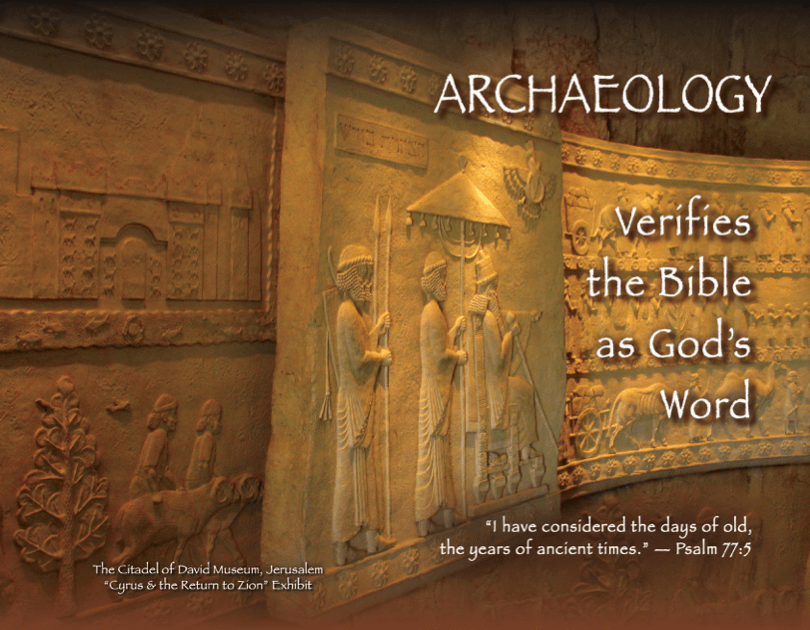
Archaeology Verifies The Bible As God’s Word
TABLE OF CONTENTS
Preface i
- A Christian Skeptic Discovers God in Ancient Israel
- Sir William Ramsay Defends the New Testament
- Was the Jesus of the Bible Fact or Fiction?
- Addendum: The People of Israel Enter Their Land
- Bible Minimalists Back Again!
- King David Was for Real! And So Was Solomon!
- Other Kings of Israel and Judah
- Biblical Archaeology’s Biggest Digs
- Two Outstanding Digs
- Dead Sea Scrolls
- Archaeological Evidence Verifies Biblical Cities
- Conclusion
Preface
Why Biblical Archaeology Is So Important
How do we know the Bible is the inspired Word of God? Actually, science does prove the Bible is inspired. There are several fields of science that are effective to this end. The most effective is Archaeology. And that is the purpose of this booklet — Archaeology Verifies the Bible.
However, there is another reason this booklet is important and that is Palestinian propaganda. The following is an example of the gross lying attempt of Palestinian scholars to replace Jewish valid history with Palestinian replacement history, which is distorted and false propaganda.
PA Chairman Mahmoud Abbas and the Palestinian Authority continue to deny Israel’s 3,000 years of history in Jerusalem, claiming it is solely an Arab, Muslim and Christian city. Abbas referred to Israel’s presence and activities in Jerusalem as “Judaization” and stated that Israel is stealing what he called the “cultural, human, and Islamic-Christian religious history.”
Abbas’ advisor for Jerusalem said that Israel is trying: “to create an artificial heritage with a Jewish spirit at the expense of its true and authentic [identity] as an Arab, Islamic and Christian city.”
This is not the first time that Abbas has denied Jewish history in Jerusalem and claimed the city for Islam alone. Palestinian Media Watch has reported that Mahmoud Abbas said that taking Jerusalem from Israel is a religious Islamic obligation of the highest level, a “fard ayn” — a personal Islamic commandment incumbent on every Muslim:
“I say to the leaders of our Arab nation and to its peoples: Jerusalem and its environs are a trust that Allah entrusted to us. Saving it [Jerusalem] from the settlement monster and the danger of Judaization and [land] confiscation is a personal [Islamic] commandment [Arabic: fard ayn] incumbent on all of us. Therefore, I call all of you to serious and urgent action to save [Jerusalem] and to make available all possibilities in order to strengthen our resolve and to maintain its historical, cultural and religious character.” [Al-Jazeera TV, March 27, 2010]
In a different speech, Abbas said in 2010:
“The oppressor will not last in Jerusalem; the oppression will not endure. Victory will come, Allah willing. This land is Allah’s best land, for which He chooses the finest of His believers, as it is written in the words of the Prophet [Muhammad].” [Al-Hayat Al-Jadida, July 11, 2010]
Abbas’ Minister of Religion Mahmoud Al-Habbash claimed that Jerusalem has been:
“throughout history, the capital of the Palestinian state and the capital of the Palestinian people.” [PA TV (Fatah), Aug. 20, 2010]
Neither claim is correct. There has never been a Palestinian state and Jerusalem was never the capital of an Arab or Muslim state. Nonetheless, the minister warned there would be religious war over Jerusalem:
“The term ‘war’ cannot be erased from the lexicon of this region as long as Jerusalem is occupied.” [PA TV (Fatah), Aug. 20, 2010]
The Palestinian Authority Mufti Muhammad Hussein likewise recently denied Jewish history in Jerusalem:
“They [Jews] want to say or suggest that this place [i.e., the Temple Mount] was once, according to their claim, a Temple. However, in truth, there never was a Temple in any period, nor was there, at any time, any place of worship for the Jews or others at the Al-Aqsa Mosque site [i.e., which was built on the Temple Mount, 705 AD].” [PA TV (Fatah), Jan. 5, 2012]
New Arab Book Furthering Anti-Semitic Blood Libels
Dr. Omar Ja’ara, lecturer at Al-Najah University in Nablus specializing in Israeli affairs, said on Fatah television on February 15 that Moses led the Muslims out of Egypt and that the Exodus was the first instance of Palestinian’ liberation through armed struggle, reported the Palestinian Media Watch.
“We must make clear to the world that David in the Hebrew Bible is not connected to David in the Quran,” he said. “Solomon in the Hebrew Bible is not connected to the Solomon in the Quran and neither is Saul or Joshua son of Nun.
“We have a great leader, Saul, who defeated the nation of the giants and killed Goliath. This is a Muslim victory.
“The Muslims of the Children of Israel went out of Egypt under the leadership of Moses and unfortunately, many researchers deny the Exodus of these oppressed people who were liberated by a great leader like Moses the Muslim, the believing leader, the great Muslim, who was succeeded by Saul, the leader of these Muslims in liberating Palestine,” Ja’ara claimed.
“This was the first Palestinian liberation through armed struggle to liberate Palestine from the nation of giants led by Goliath,” he added. “This is our logic and this is our culture.”
It is sickening to even print this gross propaganda. Our booklet reveals how archaeology completely refutes any Palestinian claim to the Land of Israel, but more important it will use archaeology to prove the Bible is indeed God’s inspired Word.
CHAPTER ONE
A Christian Skeptic Discovers God In Ancient Israel
William Foxwell Albright, the son of missionary parents, as a young man of faith eagerly pursued his college education. Finally, he received the coveted Ph.D. — but at great cost. His faith had been destroyed by the 19th century German school of higher criticism. The leading exponents of this school of higher criticism, Wellhausen and Delitzach, were out to prove that the Old Testament history of the Bible was mere fiction. Why? Wellhausen and Delitzsach were known as anti-Semitic.
What is Old Testament history but the history of the Jewish people and their glorious nation—Israel? It is not a coincident that anti-Semitics would attempt to destroy the history of the Jewish people as a nation raised up by God. They did this by teaching that most of the books of the Bible were fiction written long after the Babylonian exile, or even in the Hellenistic Period. This treacherous ploy effectively wiped Israel out of the annals of history as a significant independent nation. The Old Testament Jewish record of a wonderful Jewish State was allegedly a fictitious propaganda tool concocted to create a false sense of pride and achievement that would inspire an aggressive Jewish people to dominate others. Fortunately, Albright, almost single-handedly, would destroy this ploy. But first, his credentials.
William Foxwell Albright, considered the dean of 20th century archaeology, did significant archaeological work in Palestine.
A Christian Skeptic Discovers God In Ancient Israel Credentials
William Foxwell Albright, considered the dean of 20th century archaeology, was a legend in his time. He earned the nickname “the great authenticator” because of his ability to quickly date archaeological artifacts. During his extraordinarily fruitful life,
Albright produced over 1,100 books and articles, was awarded 30 honorary doctorate degrees, and institutions were named after him. Albright received his Ph.D. from Johns Hopkins University in 1916, where he mastered Hebrew, Akkadian (Babylonian), Spanish, French, German, Latin, and Greek. Albright was the leading Orientalist of his Age.
In 1920, Albright arrived in Jerusalem and made his home at the American School of Oriental Research, which was renamed the William Foxwell Albright Institute of Archaeological Research a year before his death. He was Director of the American School of Oriental Research in Jerusalem from 1922-1929 and 1933-1936.
During this time Albright also took a professorship at John Hopkins in 1927 and was W. W. Spence Professor of Semitic Languages from 1930-1958.
Albright held many other significant organizational positions, such as the presidency of: Palestinian Exploration Society (1921-1922, 1934-1935); American Oriental Society (1935-1936); Society of Biblical Literature (1938-1939); and the International Organization of Old Testament Scholars (1956-1957). He served on various committees of the American Philosophical Society, in particular the Research Committee, and was a recognized authority on the Qumrân (Dead Sea) Scrolls. Albright did significant archaeological work, excavating such sites in Palestine as Gibeah (Tell el Fûl, 1922), Tell Beit Mirsim (1933-1936), and the Timna expedition in South Arabia (1950-1951).
Will the Real God Stand Up?
Albright’s excavations dealt with the ancient nations in the Land of Canaan that later became the Land of Israel. He unearthed the religious practices of the Canaanite nations, who worshiped both gods and goddesses. He found their deities lied, they stole, they murdered, and committed adultery. To a skeptic like Albright, god was nothing more than the figment of man’s imagination, a reflection of himself. Man steals, lies, murders, and commits adultery— therefore, his god does the same thing.
But when Albright excavated the ancient civilization of Israel, he was astonished! Not only was their social structure different, but he discovered that the Israelite God did not steal; he did not lie; he did not murder. The Israelite God was a God of ethics—ethics that were contrary to man’s passions. The God of Israel was not a figment of the imagination of he Israelites. They did not make him or create him. Could Israel’s God be the genuine God—the true and living God of the universe? Albright the skeptic was becoming Albright the theist—a believer in the God of Israel.
The impact of the contrast of the God of Israel versus the false pagan deities drove Albright to conclude that the God of Israel was a personal God—the pagan deities were human personalities with all the frailties and vices of human beings. He reflected that the God of Israel was always thought of and represented as a person with the emotions of human beings, but with none of their frailties.
The Bible — God’s Revelation to Man
At first Albright had been determined to use the spade of archaeology to challenge all aspects of biblical history. After all, Albright had written his Ph.D. thesis in defense of the German school of higher criticism, that biblical history was mere fiction. But his archaeological discoveries turned him into a believer in the Judaic Bible. Albright concluded:
“The excessive skepticism shown toward the Bible by important historical schools of the 18th and 19th centuries . . . has been progressively discredited. Discovery after discovery has established the accuracy of innumerable details, and has brought increased recognition to the value of the Bible as a source of history.
“There can be no doubt that archaeology has confirmed a substantial historicity of Old Testament [the Judaic Bible] tradition.
Albright found the biblical account of the origin of nations unequaled in comparison to the distorted legends of secular history:
“The Table of Nations” in Genesis 10, according to Albright, “remains an astonishingly accurate document.”
“Hebrew national tradition [the Judaic Bible] excels all others in its clear picture of tribal and family origins [of other nations]. In Egypt and Babylonia, in Assyria and Phoenicia, in Greece and Rome, we look in vain for anything comparable. There is nothing like it in the tradition of the Germanic peoples. Neither India nor China can produce anything similar, since their earliest historical memories are literary deposits of distorted dynastic traditions . . . .”
Albright was awed with the God of Israel. Here was a God who was all-powerful, caring, and above all trustworthy. A God who dared to create man in his likeness — possessing intelligent, moral values and free will. A God who could nurture, not coerce, that free will for the eternal welfare of all. Finally, Albright had found a God to whom he could entrust his life.
The so-called gods of the ancient nations were tribal or ethnic in dominion. Yahweh, the God of the universe, was concerned with the welfare of all humankind. True, He had chosen to reveal Himself for the most part through Israel. But, far from showing partiality, the Jewish people were held to greater responsibility commensurate with their greater enlightenment and blessings. God’s severe chastening on Israel was part of how God was revealing His character and purposes to both the Jewish people and to humankind.
Down through history few nations have suffered as Israel. Yet, God preserved them. No ancient polity has been destroyed, its people scattered to the ends of the earth, then, nearly 2,000 years later regathered to their ancestral homeland to be reborn as a nation. What a miracle of history! The details of this national destruction, dispersion, centuries’ sojourn in diaspora, regathering and rebirth were all predicted in Scripture.
Albright could no longer consider the Laws of Israel as the evolutionary accumulation of the wisdom of man codified by the sages of Israel. The Laws of Israel were not man-made. They were Divine. The shaking, thunder, lightning and trumpet of Mt. Sinai were not a myth. Indeed, this phenomenon testified to the presence of God. The spectacular excitement, demonstrations and fireworks accompanying the 4th of July, the Chinese New Year, May Day, etc., fade into insignificance compared to one of the greatest celebrations in human history — God giving His Laws to the people of Israel through the mediation of Moses. God’s Law was not only to guide Israel, it proved to be a beacon light for all humankind. To the degree that nations heeded God’s Law, they were the better for it. How could such an awesome occasion occur without Divine spectaculars?
Albright’s conviction that the Laws of Israel defy crafting by finite man — that they are the crafting of an infinite God — still stands. This was the God Albright discovered by confirming the authenticity of the Judaic Bible with the spade of archaeology.
Albright’s Objectivity
Albright’s quest for truth was only equaled by his objectivity. Few scholars have attained such objectivity in research.
“. . . My initially rather skeptical attitude toward the accuracy of Israelite historical tradition,” Albright recalled, “had suffered repeated jolts as discovery after discovery confirmed the historicity of details which might reasonably have been considered legendary.”
F. C. Moore concurred when he wrote, “More than any scholar of his generation, I believe, Albright has been open to change and to novelty . . . openness and flexibility are hallmarks of his scholarly faculties.”
Y. Yadin wrote: “Few indeed are the scholars who are as ready as he [Albright] is to modify or reject their personal theories in the light of new finds or justified criticism. It is this rare quality which had enabled Albright to absorb successive waves of new information and thus remain in the vanguard of research and learning . . . nor is he reluctant to abandon his own theories, even if this leads to the collapse of an entire section of his teachings.”
Sir William Ramsay devoted his whole life to archaeology. Having set out to show the Bible false, he learned what many others have been forced to acknowledge. When we objectively examine the evidence for the Bible’s accuracy and veracity, the only conclusion we can reach is that the Bible is true.
CHAPTER TWO
Sir William Ramsay
Defends the New Testament
Sir William Ramsay, an atheist and the son of atheists, tried to disprove the Bible. He was a wealthy person who had graduated from the prestigious University of Oxford. Like Albright, Ramsay studied under the famous liberal German historical school in the mid-19th century. Esteemed for its scholarship, this school also taught that the New Testament was not a historical document. As an anti-Semitic move, this would totally eradicate the Nation of Israel from history. With this premise, Ramsay devoted his whole life to archaeology and determined that he would disprove the Bible.
He set out for the Holy Land and decided to disprove the book of Acts. After 25 or more years (he had released book after book during this time), he was incredibly impressed by the accuracy of Luke in his writings finally declaring that ‘Luke is a historian of the first rank; not merely are his statements of fact trustworthy’ . . . ‘this author should be placed along with the very greatest of historians’ . . . ‘Luke’s history is unsurpassed in respect of its trustworthiness.’
Luke’s accuracy is demonstrated by the fact that he names key historical figures in the correct time sequence as well as correct titles to government officials in various areas: Thessalonica, politarchs; Ephesus, temple wardens; Cyprus, proconsul; and Malta, the first man of the island. The two books, the Gospel of Luke and Book of Acts, that Luke has authored remain accurate documents of history. Ramsay stated, “This author [Luke] should be placed along with the very greatest of historians.”
| Luke 3:1 In Luke’s announcement of Jesus’ public ministry (Luke3:1), he mentions,“Lysanius tetrarch of Abilene.” | New Testament |
| Scholars questioned Luke’s credibility since the only Lysanius known for centuries was a ruler of Chalcis who ruled from40-36 BC. | Higher Criticism |
| However, an inscription dating to be in the time of Tiberius, who ruled from 14-37 AD, was found recording a temple dedication which names Lysanius as the “tetrarch of Abila”near Damascus. This matches well with Luke’s account. | Archaeology Verifies the Bible |
Sir William Ramsay Defends the New Testament
Finally, in one of his books Ramsay shocked the entire intellectual world by declaring himself to be a Christian. Numerous other archaeologists have had similar experiences. Having set out to show the Bible false, they themselves have been proven false and, as a consequence, have accepted Christ as Lord.
In an outstanding academic career, Ramsay was honored with doctorates from nine universities and eventually knighted for his contributions to modern scholarship. Several of his works on New Testament history are considered classics. When confronted with the evidence of years of travel and study, Sir William Ramsay learned what many others before him and since have been forced to acknowledge: When we objectively examine the evidence for the Bible’s accuracy and veracity, the only conclusion we can reach is that the Bible is true.
Later Archaeologists Confirm Ramsay
In all, Luke names thirty-two countries, fifty-four cities, and nine islands without error.
A. N. Sherwin-White states, “For Acts the confirmation of historicity is overwhelming . . . . Any attempt to reject its basic historicity must now appear absurd. Roman historians have long taken it for granted.”
| Acts 28:7In Acts 28:7, Luke gives Plubius, the chief man on the island of Malta, the title, “first man of the island.” | Acts 19:22 and Romans 16:23 In Acts 19:22 and Romans 16:23, Erastus, a coworker of Paul, is named the Corinthian city treasurer. | Acts 18:12-17In Acts 18:12-17, Paul was brought before Gallio, the proconsul of Achaea. | New Testament |
| Scholars questioned this strange title and deemed it unhistorical. | Higher Criticism | ||
| Inscriptions have recently been discovered on the island that indeed gives Plubius the title of “first man.” | Archaeologists excavating a Corinthian theatre in 1928 discovered an inscription.It reads, “Erastus in return for his aedilship laid the pavement at his own expense.”The pavement was laid in 50 AD. The designation of treasurer describes the work of aCorinthian aedile. | At Delphi an inscription of a letter from Emperor Claudius was discovered. In it hestates, “Lucius Junios Gallio, my friend, and the proconsul of Achaia . . .”Historians date the inscription to 52 AD, which corresponds to the time of the apostle’sstay in 51 AD. | Archaeology Verifies the Bible |


Herod’s Summer Palace on Masada
wCHAPTER THREEw
Was the Jesus of the Bible
Fact or Fiction?
The Quest for the Historic Jesus
Archaeological evidence corroborates specific persons and events
mentioned in the Gospels that were interactive in Jesus’ life. The
accuracy of the Gospel writers and the trustworthiness of the historic
message they conveyed is corroborated.
It is this simple. All agree the Gospel accounts show that Jesus
lived for 33 1⁄2 years — sometime between 4 BC and AD 36. If we can
archaeologically prove certain events and individuals recorded in the
four Gospels actually occurred in the timeframe of Jesus’ life, then we
can conclude the Bible account of Jesus’ life is true. The following is
a secular historical list of the very persons and events that interplayed
in Jesus’ life.
1. Herod the Great
History records that Herod the Great was the Roman appointed
king over Judea from 36 BC until his death in AD 4. The Bible reveals
Jesus was born and that Herod the Great attempted to kill the babe
Jesus. Archaeology has discovered Herod had two main building
projects: (1) A summer palace on Masada and (2) the Herodium,
which was a colossal monument to his life and was to be his burial
place. Archaeologists found Herod’s name on several artifacts in both
palaces.
Herod’s Palace Fortress at Herodium
11
12 Was the Jesus of the Bible Fact or Fiction?
2. Capernaum
I saw the foundation of the actual synagogue Jesus preached
in at Capernaum. A first century date (the time of Jesus) for this
synagogue’s foundation has been established by the pottery find
which corresponds to Jesus’ lifetime. (Matt. 8:5-13; Luke 7:1-10) A
limited synagogue wall still remains. Down the road in Capernaum
was the house of Peter where Jesus healed Peter’s mother-in-law.
(Matt. 8:14,15) Peter’s house was identified by the same black basalt
wall as was the synagogue.
3. Bethsaida
The ancient city of Bethsaida was where Jesus preached. (Matt.
11:21) I had the opportunity to help in the ongoing archaeological dig
in Bethsaida.
4. Caiaphas, the High Priest
Caiaphas was the notorious High Priest who presided over the trial
of Jesus. (John 18:24-28) The actual ossuary Caiaphas was buried in has
been found by archaeologists. It was exquisitely ornate and decorated.
Obviously it had belonged to a high ranking person that could afford
such an ossuary. Archaeologists agree that Caiaphas was the man.
5. Pontius Pilate
History has recorded that for ten years Pontius Pilate was the
Roman Prefect in charge of Judea. In 1961 a stone plaque was
discovered in an excavation. It had the Latin inscription, “Pontius
Pilate, Prefect of Judea.”
Things equal to the same thing are equal to each other. This is an
axiom that is universally accepted. Archaeology has proven that
Herod the Great, Capernaum, Bethsaida, Caiaphas, and Pontius Pilate
were individuals or places that existed during the lifetime of Jesus.
The Bible teaches Jesus historically had interplay with each of these
persons or places. Therefore, the Bible and archaeology prove that
Jesus did exist. Yes, the Bible is true — JESUS DID EXIST!
Was the Jesus of the Bible Fact or Fiction? 13
Addendum: The People of Israel Enter Their Land
Just as archaeology has proven the existence of Jesus, the most
important man in the Bible, archaeology also verifies the entrance of
the people of Israel, God’s chosen people, into the Land of Canaan,
later renamed the Land of Israel.
Moses was instructed in Deut. 27:4-8 to build an altar on Mt. Ebal
when Israel crossed over the Jordan River and entered the Promised
Land. The altar was to be made of whole stones without an iron tool
shaping it. In 1980 an agnostic archaeologist Adam Zertal discovered
an altar under a layer of stone on Mt. Ebal.
In researching, Zertal realized his “find” completely fit the
altar’s description in Deut. 27:4-8. Additionally, over 4,000 bones
were found in the area . . . all of them bones of sacrificial animals
mentioned in Moses’ Law.
One discovery at the site seemed to tie everything together. It was
an Egyptian scarab that was probably among the spoils the Bible says
Israel took with them from Egypt. Overwhelmed, Adam Zertal, the
agnostic, became a believer in the Bible as the Word of God.
Altar on Mt. Ebal
wCHAPTER FOURw
Bible Minimalists
Back Again!
Unfortunately, the “Biblical minimalists” or “Biblical nihilists” are
back again. This time with both an anti-Semitic and a political
agenda. They are distorting archaeology to defend Palestinian land
rights by attempting to prove there is no historical evidence of a
Jewish State. Fortunately, there are highly esteemed scholars
qualified to unmask their political agenda. This controversy came to
a head in October 2002 at the Bible and Archaeology Fest held in
Toronto, Canada, and was evaluated in an article that appeared in the
Toronto Globe and Mail.
Dr. Hershel Shanks, editor of the Biblical Archaeology Review
(flagship of archaeology periodicals), observed that the scholarly
debate has become tinged with more than a hint of present day
politics.
“They’re writing books with titles like The Invention of
Ancient Israel: The Silencing of Palestinian History —
not very subtle attempts to subvert the historical
premise of the modern Jewish state.”
As early as thirteen centuries BC and 200 years before the birth of
David, a stele exhibited in the Cairo Museum states that Pharaoh
Merneptah boasted of his army’s invasion of Israel. “This is very
inconvenient stuff for minimalists,” Dr. Shanks said, “because there’s
no other way to read it. This is a clear reference to ancient Israel.”
The elder statesman of American Archaeologists William Dever,
of the University of Arizona, stated, “I think it’s important to unmask
14
Bible Minimalists Are Back Again 15
these people. They are not biblical scholars. They are certainly
not archaeologists. They are social engineers manipulating the
biblical texts for their own goals.”
Harvard University’s eminent Frank Moore Cross put it bluntly in
the pages of Biblical Archaeology Review by observing that they
are “driven by anti-Semitism.”

Pharoah Merneptah’s Stele telling of his invasion of Israel.
Cairo Museum
Tel Dan
wCHAPTER FIVEw
King David Was for Real!
And So Was Solomon!
Every possible effort has been made by the minimalists to
fictionalize King David. Why? Once he is proven to have
been a reality of history ruling a dynamic empire as far back as the
10th century BC then the history of the Jewish nation, Israel, ruled
by David’s descendants, automatically follows as an historic fact.
The archaeological spade has transformed the claim of Palestinian
roots from the realm of possible history to complete fantasy. Yes,
King David was for real!
In 1993 archaeologists discovered the names of David and Israel
in an inscription carved in stone only 100 years after David’s death.
The Biblical Archaeology Review, March/April 1994, p. 26,
reports:
“It’s not often that
an archaeological find
makes the front page of
the New York Times (to
say nothing of Time
magazine). But that is
what happened last
summer to a discovery
at Tel Dan, a beautiful
mound in northern Galilee,
at the foot of Mt. Hermon
beside one of the headwaters
of the Jordan River.”
17
18
King David Was for Real! And So Was Solomon!
King David Was for Real! And So Was Solomon! 19
In honor of Jerusalem Day 2007, archaeologists revealed a
number of seals from the time of the Biblical Kings David and
Solomon. The seals, along with other recently uncovered artifacts,
were displayed for the first time marking forty years since the
liberation and unification of Jerusalem by the modern State of
Israel.
These artifacts reveal that the City of David, ancient
Jerusalem, was a commercial and trading center during David’s and
Solomon’s reigns—even having a postal system. Agnostic scholars
have claimed that if there was a City of David in that time frame it
was a “Sleepy Hollow.” How wrong they are! Actually an elaborate
city existed under King Saul before David became king.
Khirbet Qeiyafa/ Ha’arayim
“Ha’arayim” in the valley of Elah is unique! Carbon-14 dating
tested it back to the 10th and 11th century BC, just prior to David
becoming king. The Biblical name of this city being excavated was
“Ha’arayim” which means “two gates,” and it actually has two
gates. Since the gate was the weakest place of defense in ancient
cities, they only had one gate. 1Samuel 17:52 in the Hebrew
mentions a city named, Ha-arayim, which means “two gates.” Yes,
“Two Gates” was the actual name of a city. And this is the only
city mentioned in the Old Testament with two gates. What an
archaeological find!
Remember the minimalists claimed King David was only a
myth or a small tribal chief in the 8th or 9th centuries. What
mockery! Remember Carbon-14 dated this two-gated city
“Ha’arayim” back to the 10th and 11th centuries BC. 1Samuel
17:38-53 definitely proves the Biblical lad David lived in the late
11th or 10th centuries BC. Why? Contextually, 1Samuel 17:38-53
tells the story of David and Goliath. The writer actually toured the
excavation of this incredible city. I went to the south gate and
looked down the slope. My heart pounded. I could see the very
brook where David took five stones, one of which he used in his
slingshot to kill Goliath. Then, in my mind, I pictured the army of
ancient Israel defeating the Philistines.
I went back into the excavation, and the director showed me ink
writing on a piece of pottery they found. A number of scholars have
“David” at Tel Dan
Here Avraham Biran and his team of archaeologists found a
remarkable inscription from the 9th century BC that refers both to
the “House of David” and to the “King of Israel.” This is the first
time that the name David has been found in any ancient inscription
outside the Bible. That the inscription refers not simply to a
“David” but to the House of David, the dynasty of the great
Israelite king, silences the minimalists.
Later another scholar found the name “house of David” in the
inscriptions of the famous Moabite Stone, dated about 100
years after David’s reign. It has been observed that it is hard
to understand how David’s name could appear in (ancient) historical
records if he were nothing but a legend.
20 King David Was for Real! And So Was Solomon!
read this writing. They all agreed that it was the earliest ancient
Hebrew that has been discovered. Imagine! Ancient Hebrew from
over 3,000 years ago! What did it say? It was a tender plea to care
for the slaves, the widows, the orphans, the strangers, the
infants and the poor. Yes, the Jews over 3,000 years ago were
endeavoring to live the ideals of their Torah — the first five books
of their Bible. Many bones of animals were discovered. But there
were no pig bones found. Why? As Jews, they were abiding by
God’s Laws for them. Also, the inhabitants observed the second
of the Ten Commandments prohibiting belief in graven
images. Again, verifying they were Jews.
Khirbet Qeiyafa/ Ha’arayim, constructed as a fortified city, was
about twenty miles southwest of Jerusalem. A fortified city twenty
miles from the capital indicated that Jerusalem was a strong
municipality, for the 11th century. Not until 17 centuries later did
Mohammed formulate the religion of Islam and unite the warring
tribes of Arabia. What audacity for the Palestinians to claim the
historic right to Jerusalem!
Was King David a Myth?
King David is prominently mentioned 1,048 times in the Bible.
In the Old and New Testaments he is the prominent figure in the
genealogy of Jesus, who as David’s (genealogical) son, will inherit the
throne of his genealogical father David. When David captured
Jerusalem, he enlarged it, surrounded it with a wall and called it the
City of David.
Yet for decades archaeologists have carried out excavations
throughout the “so-called” City of David and elsewhere, searching
in vain to prove that there was such a person as David. Agnostics
and atheists were delighted. But the reason no written records were
found is that the ancient Israelis wrote their records on perishable
papyrus. This contributed to the “school of minimalists,” who for
their political, anti-Semitic or anti-theistic agenda, refused to admit
that the nation of Israel was already a thriving major state, in the
10th century BC, under the rule of a dynamic King David.
Although, in 1993 there was a startling find at the site of Tel
Dan in northern Israel, far from Jerusalem. An inscription was
King David Was for Real! And So Was Solomon! 21
found containing the phrase “the house of David.” But the minimalists
attempted to undermine this find.
Eilat Mazar
In 2004, I had an hour long meeting with the famous
archaeologist, Eilat Mazar. She is a biblical archaeologist in the
highest sense of the word. She said that she excavates “with the
Bible in one hand and a shovel in the other.” Probably Mazar
knows the Jewish Bible, our Old Testament, better than most
Christains. She said that by searching the Bible she knew exactly
where King David’s palace was located and when she received the
necessary financial backing, she would excavate and uncover the
remains of King David’s palace.
King David’s Palace
This stone stepped pile of rocks helped support King David’s
elaborate palace. The structure below was part of the City of
David that David came down to for the Philistine attack.
22 King David Was for Real! And So Was Solomon!
She observed that one of the reasons researchers were at a loss
in finding King David’s palace was that they assumed King David
built his palace at the most protected part of the city — inside the
City of David’s walls. However, she said this was not the case. The
City of David, which was almost impregnable, was also very small,
approximately nine acres in size. Nevertheless, scholars continued
to search for King David’s residence within the city walls. No
remains were found that pointed to the existence of a great palace
like the Bible describes. This contributed to the “No David school
of thought.”
Remember, Eilat Mazar “excavated with the Bible in one hand
and a shovel in the other hand.” “One of the main clues in finding
David’s palace,” said Mazar, “was surprisingly from the Bible
itself.” 2 Samuel 5:17 states that when the Philistines heard that
David was anointed king over Israel, they went up in full force to
search for him. But David heard about it and “went down” from
his palace to the walled City of David.
The Philistines suffered defeat by King David’s forces. How?
The Bible is careful to indicate that the palace was located above
the citadel or walled city of ancient Jerusalem. Mazar observed,
“The Bible would not have said ‘went down’ unless David indeed
did go from his palace, down the slopes of the Ophel mountain, to
the citadel. Consequently, his palace must have been located north
of the city, not in the center of it.”
The Philistine invasion took place after the completion of
David’s new palace, but before the northern fortifications
were sufficiently finished. Therefore, King David, who was
already living in his new residence, which was not yet strong
enough to withstand a major assault from the north, regrouped
south of his palace in the old City of David, the ancient
Jerusalem, that he had previously captured. and the Philistines
were defeated.
This Biblical account of King David’s war with the Philistines
proved to Dr. Mazar that David’s palace was north of the ancient
walled city of Jerusalem. So she excavated and there stood the
remains of a palace. As Mazar viewed the grandiose complexity of
this early Israelite building that marked it an unprecedented monumental
edifice, Mazar exclaimed, “This can only be King David’s royal
palace.”
King David Was for Real! And So Was Solomon! 23
She observed, “This area was not only available but also
desirable. It was protected on the south by the citadel and the old
city, and on the east and west by the deep slopes of the Kidron and
Tyropoeon valleys.”
Thus, archaeology proved David was not a myth. In reality,
King David was the greatest king in the history of Israel.
King Solomon’s Wall
Dr. Mazar’s next ambition was to excavate King Solomon’s
palace. Remember Eilat Mazar said that she excavates “with
the Bible in one hand and a shovel in the other.” She analyzed
1 Kings 3 which talks of Solomon building his own palace, “and
the house of the Lord, and the wall of Jerusalem round about.”
Following this clue she dug and found Solomon’s Wall.
Moreover, this wall not only confirms the presence of
Solomon in Jerusalem, it confirms the biblical narrative of Israel as
a large and advanced kingdom.

Dr. Eilat Mazar, Hebrew University of Jerusalem
archaeologist, points to the 10th century BC excavations that
were uncovered under her direction in the Ophel area adjacent
to the Old City of Jerusalem.
24 King David Was for Real! And So Was Solomon!
Speaking at the official unveiling ceremony, Dr. Mazar stated
again that the “reality was that a very highly skilled fortification
and sophisticated fortification was built by King Solomon.” The
wall contains the largest hewn stones from the First Temple period
ever found in Israel. Only a thousand years later, with the
construction by Herod the Great, are greater-size building blocks
found in Jerusalem.
Within the surrounds of the Solomon wall, Dr. Mazar and her
team discovered other artifacts, including pottery shards, dating to
the First Temple period (10th to 6th centuries BC) and confirming
the biblical narrative of the presence of a major Israelite kingdom.
The Ophel site includes a large gatehouse, royal edifices, a number
of mikva’ot (ritual baths) and a dozen pithoi, or clay jars. Engraved on
one of the remnants of the pithoi was a partial Hebrew inscription
indicating that it belonged to a high-level government official.
The 6-meter-high gatehouse was a particularly stunning
discovery. Constructed in a style typical of the First Temple period, and
much like others uncovered in Megiddo, Beersheva and Ashdod,
Dr. Mazar believes the gatehouse is actually the “Water Gate”
mentioned in Nehemiah 3:25-26: “Pedaiah … and the temple
servants living on Ophel repaired to a point opposite the Water
Gate on the east and the projecting tower.”
“A comparison of this latest finding with city walls and gates
from the period of the First Temple, as well as pottery found at the
site, enable us to postulate with a great degree of assurance that the
wall is that which was built by King Solomon in Jerusalem in the
latter part of the 10th century BC,” said Mazar.
“This is the first time that a structure from that time has been
found that may correlate with written descriptions of Solomon’s
building in Jerusalem,” she added. “The Bible tells us that Solomon
built — with the assistance of the Phoenicians, who were outstanding
builders — the temple and his new palace and surrounded them
with a city, most probably connected to the more ancient wall of the
City of David.”
The 6-meter-high gatehouse of the uncovered city wall
complex is built in a style typical of those from the period of the
First Temple like Megiddo, Beersheva and Ashdod. It has a
symmetrical plan of four identical small rooms, two on each side
King David Was for Real! And So Was Solomon! 25
of the main passageway. Also there was a large, adjacent tower,
covering an area of 24 by 18 meters, which was intended to serve
as a watchtower to protect entry to the city. The tower is located
today under the nearby road and still needs to be excavated.
Nineteenth-century British surveyor Charles Warren, who
conducted an underground survey in the area, first described the
outline of the large tower in 1867 but without attributing it to the
era of Solomon.
“Part of the city wall complex served as commercial space and
part as security stations,” explained Mazar. Within the courtyard of
the large tower there were widespread public activities, she said. It
served as a public meeting ground, as a place for conducting
commercial activities and cult activities, and as a location for
economic and legal activities.
Pottery shards discovered within the fill of the lowest floor of
the royal building near the gatehouse also testify to the dating of the
complex to the 10th century BC. Found on the floor were rem-
nants of large storage jars, 1.15 meters in height, that survived destruc-
tion by fire and that were found in rooms that apparently served as
storage areas on the ground floor of the building. On one of
the jars there is a partial inscription in ancient Hebrew indi-
cating it belonged to a high-level government official.
“The jars are the largest ever found in Jerusalem,” said Mazar,
adding that “the inscription on one of them shows that it belonged
to a government official, apparently the person responsible for
overseeing the provision of baked goods to the royal court.”
In addition to the pottery shards were seal impressions on jar
handles with the words “to the king,” testifying to their usage within
the monarchy. Also found were seal impressions (bullae) with
Hebrew names, also indicating the royal nature of the structure.
Between the large tower at the city gate and the royal building,
the archaeologists uncovered a section of the corner tower that is
8 meters long and 6 meters high. The tower was built of carved
stones of unusual beauty.
East of the royal building, another section of the city wall that
extends for some 35 meters also was revealed. This section is 5
meters high and is part of the wall that continues to the northeast
and once enclosed the Ophel area.
26 King David Was for Real! And So Was Solomon! King David Was for Real! And So Was Solomon! 27
Another thrilling find, though slightly less imposing than the
colossal wall or gate house, was the discovery of a fragment of a
3,000-year-old clay tablet covered with cuneiform script.
Discovered in the Ophel dig and currently on display at the
Davidson Center in Jerusalem’s Old City, experts say it is the
oldest written document ever found in Jerusalem.
Looking at the wall’s impressive size and sophisticated
engineering, it is clear that it wasn’t hastily patched together! No,
contrary to the claims of the minimalists and Palestinians, the nation
of Israel was already a classic empire in the 10th century, back in
the era of King David and King Solomon. A post office system was
an inevitable necessity.
Israel’s First Post Office
Artifacts from the City of David excavations reveal an
interesting tidbit of information about an ancient postal system, a
luxury of the Israeli empire. By the 9th century, besides government
officials, even clerks and merchants enjoyed this postal service.
Whereas, during the 9th century BC, letters and goods were
dispatched on behalf of their senders without names, by the 8th
century BC the clerks and merchants began to add their names to
the seals, observes the Antiquities Authority. Clay stamps sealed
the letters or packages.
A Thrilling Find on the Temple Mount
Dating Back to King Solomon
In 2012 archaeological remains dating to the First Temple Period
were discovered on the Temple Mount. Jerusalem District
Archaeologist Yuval Baruch uncovered fragments of ceramic table
wares, animal bones, and more. The bowl sherds were decorated with
wheel burnishing lines characteristic of the First Temple Period. The
finds indeed dated back to the First Temple built by King Solomon,
which existed between the 9th and 5th centuries BC.
An archaeological team of the Israel Antiquities Authority,
reached the conclusion, after examining the finds, that their
characteristics and location may aid scholars in reconstructing the
dimensions and boundaries of the Temple Mount during the First
Temple Period.
Fragments from the Temple Mount
These archaeological finds of an expanding Israeli empire
as far back as the 10th century BC, including Solomon’s Temple
on the Temple Mount, were over 16 centuries before
Mohammed created the Muslim religion. It is absolutely
unconscionable for the Palestinians Arabs to falsely claim they
occupied the Temple Mount and Jerusalem centuries before the
Jewish People. What impudence!
Naturally the Empires of King David and King Solomon had
suburbs like Khirbet Qeiyafa/Ha’arayim and Bethlehem.
Bethlehem Part of Ancient Israel
This photo made available
May 22, 2012, by Israel’s
Antiquities Authority, shows a
seal bearing the name
“Bethlehem” in ancient Hebrew
script that was just discovered.

28 King David Was for Real! And So Was Solomon!
The Israel Antiquities Authority says archeologists digging at
a Jerusalem site have found the oldest artifact that bears the inscription
of Bethlehem. This dramatic archaeological find, a half-inch clay
seal, is the earliest evidence outside the Bible for the existence of
the ancient biblical city Bethlehem.
The stamp or seal, officially called a bulla, with ancient
Hebrew script, is one of a group of bullae used to stamp official
documents that were to be opened only by authorized officials. The
writing shows that this bulla was sent from Bethlehem to the king
in Jerusalem in the seventh year of his reign.
Eli Shukrun, director of the excavation on behalf of the Israel
Antiquities Authority, said that it is unclear if the reference to the
king is to Hezekiah, Manasseh or Josiah. The seals or bullae, were
used to seal tax shipments in the Kingdom of Judah in the late 8th
century and the 7th century BC. “The tax could have been paid in
the form of silver or agricultural produce such as wine or wheat,”
according to Shukrun. He said: “The bulla belonged to a shipment
of tax documents which were sent from Bethlehem to the king in
Jerusalem, as part of a taxation system used in the Kingdom of
Judah in the late 8th and 7th centuries BC.” He added, “This is the
first time the name Bethlehem appears outside the Bible, in an
inscription from the First Temple period, which proves that
Bethlehem was indeed a city in the ancient Kingdom of Judah, and
possibly also in earlier periods.”
We think of Bethlehem as a New Testament city with the
birthplace of Jesus. But it is first mentioned in the Bible in Genesis
(Bereishit) when it is named relating to the death and burial of the
Matriarch Rachel. Bethlehem also is mentioned in the Book of
Ruth as the place where “the children of Judah dwelled,” including
the family of Boaz, who is a central figure in the Book of Ruth,
almost all of which takes place in Bethlehem. Bethlehem is cited in the
Book of Samuel as the city where David was anointed as king.
During the current Israeli-Palestinian Peace Process the city of
Bethlehem has, unfortunately, been given to the Palestinians, but as
has been seen the historic roots of the city of Bethlehem belong to
Israel. We have dealt in great detail to prove the Kingdom of David
and Solomon were an ancient grandiose reality reaching back to the
10th century BC, over sixteen hundred years before Mohammed
finally conquered the warring tribes on the Arabian Peninsula and con-
solidated them into a single Islamic State.
wCHAPTER SIXw
The Jehoash Inscription
This inscription is carved into a rectangular Arkosic sandstone
tablet, about 12 x 24 x 3 inches (30 x 61 x 8 cm). It consists of 10 or
15 lines of text in ancient Hebrew. The inscription discusses repairs to
King Solomon’s temple. Carbon-14 dating by the Geological Survey
of Israel shows that the crust on the stone is 2,300 years old.
29
Other Kings of Israel and Judah


30 Other Kings of Israel and Judah
That would be consistent with the stone being an actual relic
from the 9th century BC. Notice back in the 9th century BC this
archaeological dig like many others proves the reality of Solomon’s
Temple. A fact that is continually denied by the Palestinians.
The tablet contains an inscription in ancient Hebrew that refers to
repairs to the temple made during the reign of King Jehoash.
Remember after the death of Solomon the tribes of Benjamin and
Judah rebelled against high taxation. They separated from the nation
of Israel and formed the independent two tribe kingdom of Judah.
Now the nation of Israel only consisted of the remaining ten tribes.
The inscription says in part: “holy money . . . to buy quarry stones
and timber and copper and labor to carry out the duty with faith.” The
last sentence promises that if the work is completed well, then “the
Lord will protect his people with blessing.” The inscription relates
and verifies that the work described in 2 Kings 12:1-6 and 2 Kings
12:11-16 was actually accomplished in real time. Thrillingly the writing
on this tablet confirms the accuracy of portions of 2 Kings in the
Hebrew Scriptures (Old Testament). It would also have profound
political implications. The Hebrew scriptures teach that the temple of
Solomon was located on the Temple Mount in Jerusalem.
This could be considered one of the greatest Israeli archaeological
finds in history, as it offers physical evidence of the existence of a
Jewish Temple on the Temple Mount in Jerusalem.
King Hezekiah’s Tunnel is Archaeological Proof that Jews
Possessed the Land of Israel as Defined in the Bible
The Jewish people did not just occupy and rule the Land of Israel.
No. Archaeological digs reveal that time after time over the centuries
the actual history of Israel corresponds with the biblical history of
Israel. This is true of no other nation despite the false claims of the
Arab nations.
While the Arabs were still warring tribes, long before Mohammed
forcibly conquered them under the enforced banner of Islam, the
Jewish people were playing out their over 3,000 years’ history in the
Land of Israel. Oh yes, the Arabs controlled it for a puny 361 years,
during which they soon disdained Jerusalem as the capital of the Land
in favor of Ramla.
Other Kings of Israel and Judah 31
The Bible says “And when Hezekiah saw that Sennacherib had
come and intended to fight against Jerusalem, he planned with his
officers and his mighty men to stop the water of the springs that
were outside the city; and they helped him. A great many people
were gathered, and they stopped all the springs and the brook that
flowed through the land, saying, ‘Why should the kings of Assyria
come and find much water?’” (2 Chronicles 32:2-4 RSV). This
occurred in the 7th century BC.
King Hezekiah needed a reliable water supply for Jerusalem
during the siege, but at the same time he wanted to prevent the
Assyrian forces from using the Gihon Spring, which was located
outside the city. The Bible records Hezekiah’s solution: “This same
Hezekiah closed the upper outlet of the waters of Gihon and directed
them down to the west side of the city of David.” (2 Chronicles 32:30
RSV).
How? The water from the Gihon was diverted into the Gai wadi by
means of a tunnel 1,740 feet (530 meters) long. The tunnel work was
done simultaneously from both ends, until they miraculously met
somewhere near the middle. It was an amazing feat of engineering for
the time, as seen in the diagram below.
32 Other Kings of Israel and Judah Other Kings of Israel and Judah 33
In 1880, an inscription was discovered by a boy who was bathing
in the Gihon Spring. Carved in the rock at the end of the tunnel, it
described the meeting of the two groups of workers who had started
from opposite ends of the tunnel. Translated, it reads:
“The tunneling was completed . . . . While the hewers
wielded the ax, each man toward his fellow . . . there
was heard a man’s voice calling to his fellow . . . the
hewers hacked each toward the other, ax against ax, and
the water flowed from the spring to the pool, a distance
of 1,200 cubits . . . .”
The inscription is now in the Istanbul Museum. And what
happened to the Assyrian invaders? A great force of Assyrians did
indeed besiege Jerusalem. They called out taunts to the people inside
the city and went so far as to blasphemously insult The Lord.
Hezekiah prayed to God for deliverance. “And the angel of The Lord
went forth, and slew a hundred and eighty-five thousand in the camp
of the Assyrians; and when men arose early in the morning, behold,
these were all dead bodies.” (Isaiah 37:36 RSV) Sennacherib then
retreated to Nineveh with what little remained of his forces.
Hezekiah’s Broad Wall
In the early 1970s an archaeological mission headed by Professor
Nahman Avigad unearthed part of the city wall from the period of
King Hezekiah (end of the 8th century BC, first Temple era).
Evidently the city’s population had increased even before Hezekiah
ascended the throne, and Jerusalem expanded to the slopes of Mount
Zion. When the Assyrian army approached, the king decided to fortify
the city and wall in the newly built areas. The archaeological dig
found that houses which had stood on the planned route of the wall
were demolished and their stones used to reinforce the wall.
According to Isaiah (22:9-10): “And you took note of the many
breaches in the City of David . . . and you counted the houses of
Jerusalem and pulled houses down to fortify the wall.” The sparse
description conveys extraordinarily well the atmosphere of urgency
and drama that accompanied the building of the wall. It was a vast
project together with the hewing of the stones.
Remnants of the Broad Wall of biblical Jerusalem,
built during Hezekiah’s days against Sennacherib’s siege.
34
Other Kings of Israel and Judah
Other Kings of Israel and Judah 35
Manasseh’s Tax Bullae
New Bulla Provides Evidence of Judah’s Tax
System under King Manasseh
Clay Bullae from the City of David
Photos by Gaby Laron, The Institute of Archaeology,
The Hebrew University.
Clay Bullae from the City of David,
Jerusalem, Provide New Evidence for Biblical Figures
These clay bullae (seal impressions), discovered by archaeologist
Eilat Mazar during her excavations of the City of David, Jerusalem,
bear the names of two royal ministers mentioned in the Bible’s story
of Jeremiah, a famous prophet of the Old Testament.
The relationship between archaeology and the Bible is not always
an easy one, but sometimes they come together in striking agreement
as witnesses to history. Two small clay bullae (seal impressions)
found in the course of Eilat Mazar’s excavation of the City of
David, Jerusalem, confirm the reality of the Biblical account of the
Prophet Jeremiah, a prophet of the last kings of Judah.
The first of the clay bullae, which surfaced during Mazar’s
excavation of King David’s palace, bears the name “Yehuchal [or
Jehucal] ben Shelemyahu [Shelemiah]” The second seal was found in
the First Temple period strata just a few yards away from the first, and
reads “Gedalyahu [Gedaliah] ben Pashur” (pictured above right).
These two men are mentioned together in the Bible (Jeremiah
38:1-13) as ministers who King Zedekiah (597–587 BC) instructed to
imprison Jeremiah. Then King Zedekiah had a change of heart and
held a secret meeting with Jeremiah in the “temple of the Lord” as
recorded in Jeremiah 38:14, as the Babylonians closed in on
Jerusalem during the last years of the First Temple period.
April 15 presents a challenge to many, but taxpayers may take
some small comfort in the fact that taxes are by no means a modern
invention. A recent archaeological discovery in Jerusalem reveals a
tax system in ancient Israel. While wet sifting soil from the excavation
of an ancient refuse pit on the eastern slope of the Temple Mount,
workers discovered a small clay bulla, or seal impression, inscribed in
paleo-Hebrew script. Although some of the letters had broken off,
archaeologist and co-director of the sifting project Gabriel Barkay
reconstructs the two lines of fragmentary text to read “Gibeon, for the
king.”
The inscription puts the new find in a special group of more than
50 so-called fiscal bullae, but it is the first of these to come from a
professional excavation. Barkay thinks the bullae are evidence for a
system of ancient taxes used by Judah’s King Manasseh in the 7th
century BC. Under this system, according to Barkay, “the urban
administrative centers collected taxes in kind [i.e., grain, oil, etc.] and
then sent them on to the king in Jerusalem with the documentation
attached and sealed by these bullae identifying where it had come
from—in this case, Gibeon.”
Our Bible deals with the Kings of Israel and Judah from Saul to
Zedekiah. It is thrilling that many, Saul, David, Solomon, Hezekiah,
Manasseh, and Zedekiah, have been verified by archaeology. This
proves our Old Testament has to be inspired.
Further, How could anyone before these archaeological finds create
these exact biblical names. Impossible! Our Bible is inspired!
36
Other Kings of Israel and Judah
Other Kings of Israel and Judah 37
Jewish Temple Seal Confirms a Jewish Temple
“To the Trumpeting Place” Stone
Josephus records, “the point where it was custom for one of the
priests to stand and to give notice, by sound of trumpet, in the
afternoon of the approach, and on the following evening of the close,
of every seventh day.” (The Jewish War, IV, ix, 12)
Another remarkable discovery in biblical Archaeology and an
awesome testimony of what once was the Temple in Jerusalem!
Megiddo Seal of “Shema,” King Jereboam’s Official
An archaeological find with a satirical twist. The picture of this
seal carries the inscription “Belonging to Shema, official of
Jeroboam.” The seal was found during archaeological excavations at
Megiddo in 1904. The timeframe of this seal is, after the death of
King Solomon, when the twelve tribe kingdom of Israel, divided into
the two tribe kingdom of Judah and the ten tribe Nation of Israel. The
seal belonged to Shema an official of Jeroboam the king of the ten
tribe kingdom of Israel. (2 Kings 14:23)
The Palestinian claim that the Temple Mount was Arab, not
Jewish, is further refuted by an exciting find in 2011 AD.
Archaeologists surveying the southwestern corner of the Temple
Mount in the area of Robinson’s Arch have found a button-sized, 1st
century AD seal inscribed with the phrase “pure for God.” Israeli
Antiquities Authority archaeologists Eli Shukron and Ronny Reich
observed the seal was used to stamp objects that passed the purity
qualification for ritual use in the Jewish Temple.
Similar seals are mentioned in the Jewish Mishnah and discussed
in the Jewish Talmud. Products being brought to be used in the
Temple were stamped as pure by this seal. Yes, this archaeological
find of an ancient seal found at the southwestern corner of the Temple
Mount proves that the Temple Mount was indeed Jewish and upon it
resided the second Jewish Temple where animal sacifices were
offered.
Yes, archaeology confirms the Jewish historical claim of two
Temples on the Temple Mount!
Second Temple Era
A stone (2.43×1 m) with the Hebrew inscription “To the
Trumpeting Place” excavated by Benjamin Mazar (Eilat Mazar’s
Father) at the southern foot of the Temple Mount was a part of the
Second Temple.
38 Other Kings of Israel and Judah
The striking feature of the seal is the roaring lion which historically
was the symbol of the southern kingdom of Judah. (Genesis 49:9;
Revelation 5: 5) But what was an official of King Jeroboam of Israel
doing with the royal symbol of the rival kingdom of Judah? This
archaeological dig captures the satire between officials of rival
nations.
Remember, 2 Kings 14:12-14 reveals that Israel’s previous King
Jehoash routed Judah and captured Amaziah, king of Judah. Jehoash
went to Jerusalem and took all the gold and silver and all the articles
found in the temple of the LORD . . . . He also took hostages and
returned to Samaria.
Now the satire. When Jeroboam became king of the ten tribe
kingdom of Israel, his domain included much of the already
captured territory of the kingdom of Judah. To Shema, the official
of Jeroboam, this was amusing so he made a pun with his own
personal official seal or bulla that he used to seal his official mail.
The roaring lion was the symbol of the southern kingdom of Judah.
Imagine his smugness when he stamped an official document to an
official in Judah with his own lion stamp. You can picture him
smiling with glee!
A Self-Proclaimed King of Israel
A new document was dated to four years after the Second Jewish
Revolt. Why? The so-called Bar-Kokhba Revolt was so effective that
Rome had to rush troops all the way from England to subdue it.
Although defeated again, Jews at that time were so anxiously
hopeful to regain independence that they reckoned years from the
Bar-Kokhba Revolt.
This newly discovered 2nd century AD papyrus, found in a
Judean Desert cave, is dated in its first line to “Year 4 of the
Destruction of the House of Israel,” a reference to the Roman
takeover of Jerusalem after the Second Jewish Revolt, also known as
the Bar-Kokhba Revolt.
Archaeological digs during the First Jewish Revolt against Rome
(66–70 AD), which ended with the destruction of the Temple, reveal
the Jews minted their own coins dated to the first, second, third, fourth
and, more rarely, even fifth year of the revolt. In other words, dating
began with the beginning of the Jewish revolt. Many of the coins also
Other Kings of Israel and Judah 39
bore legends like “Jerusalem the Holy” or “Freedom of Zion.” Only
archaeology reveals these details of history.
The Romans crushed the Jewish revolt in 70 AD (except for the
holdouts at Masada), but as seen above the Jews managed to revolt
again a little more than 60 years later. This revolt, the so-called Bar-
Kokhba Revolt (132–135 AD), also known as the Second Jewish
Revolt, lasted only two-and-a-half years. Archaeological digs indicate
the coins from this revolt are much rarer. As in the First Jewish
Revolt, however, coins are dated beginning with the start of the revolt.
An example is a coin inscribed “Year 1 of the Redemption of Israel,”
or another inscribed “Year 2 of the Freedom of Israel.” Rarely, a coin
bears the legend “Year 3 of the Redemption of Israel.”
During the Byzantine occupation of the Land of Israel (4th to 7th
centuries), a different dating system developed, beginning not with
the start of a revolt, but rather the disasters that ended them. For
example, archaeological finds of synagogue inscriptions and
tombstones are sometimes dated as so many years after the
destruction of the Temple that effectively ended the First Jewish
Revolt.
Bar-Kokhba Papyrus
40 Other Kings of Israel and Judah
The Targum Hebrew rendition of Isaiah 6:12,13 agrees with history
and archaeology that a tenth of the Jewish People would remain in the
Land of Israel until end-times when their double of punishment is
ended, and as we now observe they would be regathered back to
their Land. (Jeremiah 16-18)
The Bible, natural history, and archaeology all prove that the
Palestinian claims to an ancient history in the Land of Israel are
completely false. The archaeological finds in Israel relating the
Jewish people and their Land are the most numerous and detailed in
the world thereby relegating the Palestinian’s claims to the Land of
Israel to the scrap-pile of the absurd.
Underground Ritual Baths During the Jewish Revolt
Once again archaeology confirms details of Biblical history. Not
only was Israel conquered by Rome, but Isaiah 6:11,12 and Ezekiel
33:27 predicted a devastation so great that the Jewish people, even the
priests, would hide in caves. This presented a dilemma for the Priests
and the observant Jews. How could they observe their ritual baths?
Recent investigations have identified five mikva’ot (singular:
mikveh), or Jewish ritual baths, in caves on the Galilean cliffs of
Arbel, revealing the religious orientation of the inhabitants. Priests
and others found refuge in remote caves at Arbel during the Great
Jewish Revolt against the Romans after the destruction of the Second
Temple.
Artifacts found nearby reveal that the inhabitants lived
subsistence-level lifestyles in crowded conditions. Researcher
Yinon Shivtiel observed that “the preparation of mikvehs in these
places is amazing not just because of the physical difficulty in
digging them, but because in doing so one needs to cope with all
the specifics of Jewish law that a ritual bath demands, primarily a
source of flowing water and an immersion area that has a specific
volume.”
The ritual baths at Arbel received their water from stalactites
dripping above them or from tunnels dug outside the rock walls of
the caves. Archaeological finds reveal this incredible effort to keep
“the letter of God’s Law” while Israel’s national polity was being
destroyed for their failing to additionally keep the spirit of God’s
Law.
Other Kings of Israel and Judah 41
Shivtiel and Vladimir Boslov have identified over 500 caves of
refuge in the steep cliffs, some with ritual baths.
Recent investigations by researcher Yinon Shivtiel (pictured here)
and others have identified five mikva’ot, or Jewish ritual baths, in
caves on the Galilean cliffs of Arbel, revealing the highly religious
orientation of the inhabitants.
Mikva’ot in Cave at Arbel
Biblical Archaeology’s Biggest Digs

Tel Megiddo in the Jezreel Valley
wCHAPTER SEVENw
The Mound of Megiddo
Tel Megiddo and Tel Dan in many ways have come to define the
field of Biblical archaeology. On the one hand, they are Biblical cities
associated with some of the Bible’s most famous events and figures
from the conquests of Joshua to the building programs of King
Solomon. On the other, they are the massive, imposing mounds of
stratified remains that give archaeologists material insight into the far
ancient past.
Situated in the fertile and strategic Jezreel Valley, the site of
Megiddo has long captivated the imagination of archaeologists and
Biblical scholars. The mound of Megiddo, which rises an impressive
100 feet above the surrounding valley, has revealed layer upon layer
of human occupation covering the entire span of the Bronze and Iron
Ages. Important layers and monumental structures have traditionally
been attributed to Solomon.
The Megiddo Seal
The Megiddo Seal was discovered in 1904 during the earliest
excavation of Megiddo, led by Gottlieb Schumacher. This was a seal
belonging to a royal minister in the 8th century BC. It is engraved with
the figure of a roaring lion (symbol of the kingdom of Judah) with a
beautiful curved tail and was skillfully executed. Earlier, the satirical
humor of this seal was presented (page 38).
The Megiddo Seal
43

44 Biblical Archaeology’s Biggest Digs
Another Megiddo Archaeological Dig
In 2012 archeologists at Tel Megiddo discovered a jewelry trove
they say may be one of the most valuable ever discovered from the
biblical period.
The clay vessel in which the jewels were found was excavated in
2010. In July 2012 the vessel was emptied, and experts were stunned
to find what they described as some of the most valuable jewels ever
unearthed from the biblical period. The Megiddo cache is notable for
its abundance of gold jewels, including nine large earrings and a ring
seal. It also includes more than a thousand small beads of gold, silver
and carnelian — a semi-precious stone of orange-to-amber hue. All of
the artifacts are in good condition.
Ancient gold earring
found at Megiddo.
One of the collection’s most remarkable items is a gold basket-
shaped earring bearing the figure of a bird, possibly an ostrich. Dated
from about 11 BC, researchers observed that at least some of the
jewelry originated in Egypt. What was the origin of this Egyptian
treasure trove? Remember when the Israelite slaves left Egypt, God
caused the Egyptians to give their gold and silver jewelry to the
Israelis. (Exodus 3:21,22 NASV) Yes, archaeology even verifies
details like this.
The City of Hazor
The Bible portrays Hazor as the greatest of the Canaanite city-
states (Joshua 11:10), consequently, Hazor is one of the largest
archaeological sites in all of Israel, with its great, bottle-shaped
mound covering over 200 acres. Excavations over the decades have
revealed 22 strata of occupational debris, the earliest dating to the
18th century BC.
Biblical Archaeology’s Biggest Digs 45
As dig director Amnon Ben-Tor explains in Excavating Hazor,
Part One, and Excavating Hazor, Part Two, amid those layers archae-
ologists have uncovered the impressive remains of the grand
Canaanite city that was conquered by Joshua, as well as the fortified
administrative center built by Solomon.
The City of Hazor

Two Outstanding Digs

Temple Rock on Temple Mount
Two outstanding archaeological digs — the Temple Mount Rock
and the Garden Tomb — are not generally referred to as archaeology,
but in reality they are. Archaeology is a study of history from the
remains of earlier human culture by excavation. The find can be
an intended dig or it can be the result of an accident.
At first after the Bar Kochba revolt was crushed, Jews were not
permitted on the Temple Mount. Sometime later they were permitted
to ascend the Mount once a year on Tisha B’Av. Tisha B’Av, the 9th
of Av on the Jewish calendar, is the Jewish day of mourning
and fasting to commemorate the destruction of the two Temples.
Since then, other Jewish tragedies also occurred on this same date.
The Byzantine Period, AD 135 through 638, was when Christians
ruled Jerusalem before the Dome of the Rock was constructed in AD
692. Therefore, the rock on which Abraham offered up his son Isaac
was not covered by a building—only by accumulated dirt and debris
that could be removed and was removed.
In AD 333 a Bordeaux pilgrim wrote, “. . . on the Temple
Mount . . . there was a rock with a hole in it to which Jews come
annually; they anointed it and tear their clothes, lamenting,
and sobbing. And they go away.” Similarly, other Christian writers
observed that during the Byzantine (Christian) period, AD 135
through 638, Jews visiting the ruined Temple site anointed the rock on
the Temple Mount. Thrilling and touching proof that the Jewish
Temple Mount is indeed authentic and the Jews for centuries
wCHAPTER EIGHTw
47
48 Two Outstanding Digs
annually celebrated the destruction of the two Temples on Tisha
B’Av. This was only possible because early on after AD 135, Jews
dug, i.e. excavated, on the top of the Temple Mount to find the rock
on which Abraham offered his son.
The Garden Tomb
There is a site in Jerusalem call the Garden Tomb that was actually
excavated. Over the centuries it was covered by rubble, trash and dirt.
In Jerusalem for a visit in 1883, General Charles Gordon spied a
prominent rocky crag which looked to him like it could be the place
mentioned in the Bible where Jesus was crucified. Around the corner
Gordon identified an ancient tomb and putting the two together he
located the hill of crucifixion and the nearby burial place.
Simon Brown found that ancient paintings drawn hundreds of
years before the Garden Tomb was discovered showed the site of
Gordon’s Garden Tomb to be in the exact place as the original skull
hill and the Garden Tomb were located. Further confirmation is the
tomb of Jesus, like Gordon’s Garden Tomb, was cut out of natural
rock. (Matthew 27:57-60) Notice, the tomb Jesus was buried in was
purchased by a wealthy man, Joseph of Arimathea, who had it hewn
out of stone for himself and his wife—an elaborate tomb. Remember,
the Apostle John could look in and see the main burial place. This was
unusual for most tombs at that time, but, this is true of the Garden
Tomb.
On the inside wall was a 3rd century Byzantine picture of a cross.
“Jesus tasted death for every man.” (Hebrews 2:9) He was laid in this
Garden Tomb and rose on the third day. Yes, Jesus “gave himself a
ransom for all, to be testified in due times (Greek).” 1 Timothy 2:6
The due time for the “church of Christ” is in this life. For
mankind in general it will be in the 1,000 year Kingdom of Christ.
Etched into the outside wall of the Garden Tomb was a
simple picture of a fish, which was the 2nd century symbol of
Christianity before the cross. Due to the erosion of the centuries it is
nearly worn away.
Hallelujah! Jesus died for our sins and rose for our justification!
Two Outstanding Digs 49
The Garden Tomb
Calvary
Golgotha — “The Place of a Skull”
Mark 15:22
wCHAPTER NINEw
The Dead Sea Scrolls

Qumran Cave 4, where ninety percent
of the Dead Sea Scrolls were found.
The year was 1947, and the world was engulfed in change —
World War II had ended, and the United Nations was preparing to
allow the Jewish people to form the modern nation of Israel.
Unaware of the dramas on the world stage, young Abu Dahoud
wasabouttobeginoneofthegreatestongoingdramasinworldhistory. One
of his sheep wandered into a cave. Hoping to scare the sheep out, Abu
Dahoud picked up a stone and tossed it into the hole. Instead of his
bleating sheep, however, he heard the sound of breaking dishes.
His curiosity piqued, he and a friend climbed up to the small cave.
When their eyes adjusted to the darkness, they saw several large clay
jars holding tattered scrolls. Little could Abu Dahoud have known that
one of the jars contained the oldest existing copy of the Old Testament
book of Isaiah. Neither could he have realized how his discovery
would rattle the ivory towers of a world far removed from his own.
Until 1947, scholars had only the clay tablets of Babylon and the
Egyptian papyri to help them understand background information on
the Bible, since no ancient Old Testament manuscripts were known to
have survived. However, all this changed with the discovery of over
800 papyri and parchment texts in caves along the northwest corner
of the Dead Sea. These scrolls gave the world manuscripts of Old
Testament books 1,000 years older than any previously in existence.
51
52 The Dead Sea Scrolls
As the importance of the find was realized, the world waited to
find out if the scrolls would prove that the Bible had been handed
down and translated accurately through the generations. The answer
was a resounding, Yes! The Dead Sea Scrolls confirm that from the
9th century AD, the Jewish scribal copying of Old Testament
Scriptures was accomplished with remarkably few errors. With
the exception of minute copying errors here and there, the Dead Sea
manuscripts exhibit virtually identical readings to their counterparts
of the 9th century. They prove that the doubts of many scholars
concerning the accuracy of the Masoretic text were unfounded.
For example, John Allegro, a noted non-Christian, made this
observation.
“Excitement had run high among scholars when it became known
in 1948 that a cave near the Dead Sea had produced pre-Masoretic
texts of the Bible. Was it possible that we were at last going to see
traditions differing seriously from the standard text, which would
throw some important light on this hazy period of variant traditions?
In some quarters the question was raised with some apprehension,
especially when news-hungry journalists began to talk about
changing the whole Bible in view of the latest discoveries; but closer
examination showed that, on the whole, the differences shown by the
first Isaiah scroll were of little account, and could often be explained
on the basis of scribal errors, or differing orthography, syntax, or
grammatical form.”
The Dead Sea Scrolls were discovered in 11 caves on the upper
northwest shore of the Dead Sea. The Isaiah Scroll is the oldest
complete manuscript and is free of any real differences from the
current Book of Isaiah’s Hebrew text. Fragments of every book of the
Hebrew canon (Old Testament) have been discovered except for the
Book of Esther. The Book of Nehemiah was just recently found so
there are high expectations for the Book of Esther.
There are now identified among the scrolls, 19 copies of the Book
of Isaiah, 25 copies of Deuteronomy and 30 copies of the Psalms, and
they accurately compare to each other.
Our faith in God is primarily based on scriptures nearly 4,000
years old. How thrilling to have this confirmation of the Dead Sea
Scrolls that our Old Testament is accurate!
The Dead Sea Scrolls 53
The Isaiah Scroll
A Jar the Scrolls Were Found In


Archaeological Evidence
Verifies Biblical Cities
Tel Arad, 10 km West of Modern Arad
wCHAPTER TENw
The following is a partial list of cities mentioned in the Bible that
have been verified by archaeologists. There are hundreds! This means
that the Bible accurately reflects the locations and cities of ancient
times.
Arad
Num. 21:1, “When the Canaanite, the king of Arad, who lived in
the Negev, heard that Israel was coming by the way of Atharim, then
he fought against Israel, and took some of them captive.” [NAS]
Num. 33:40, “Now the Canaanite, the king of Arad who lived in
the Negev in the land of Canaan, heard of the coming of the sons of
Israel.” [NAS]
“Arad 30 km NE of Beersheba, excavated from 1962 to 1974 by
Y. Aharoni and R. B. K. Amiran.” (The New Bible Dictionary,
Wheaton, Illinois: Tyndale House Publishers, Inc., 1962.)
“The site consists of an upper mound or acropolis, where
excavation has revealed an Iron Age (post 13th century BC).”
(Achtemeier, Paul J., Th.D., Harper’s Bible Dictionary, San
Francisco: Harper and Row, Publishers, Inc., 1985.)
Bethel
Amos 7:12-13, “Then Amaziah said to Amos, ‘Go, you seer, flee
away to the land of Judah and there eat bread and there do your
prophesying! [13] But no longer prophesy at Bethel, for it is a
sanctuary of the king and a royal residence.’” [NAS]
55
56 Archaeological Evidence Verifies Biblical Cities
“W. F. Albright made a trial excavation at Bethel in 1927. Albright
then mounted a full excavation in 1934. His assistant that year, J. L.
Kelso, continued the excavation in 1954, 1957, and 1960.”
(Achtemeier, Paul J., Th.D., Harper’s Bible Dictionary, San
Francisco: Harper and Row, Publishers, Inc., 1985.)
Dan
Judges 18:29, “They called the name of the city Dan, after the
name of Dan their father who was born in Israel; however, the name
of the city formerly was Laish.” [NAS]
“The excavation of Dan began in 1966 under the direction of
Avraham Biran.” (Horn, Siegfried H., Biblical Archaeology: A
Generation of Discovery, Berrien Springs, Michigan: Andrews
University, 1985, p. 42.)
“Formerly called Laish, it is mentioned in the execration texts, the
18th century BC Mari tablets, and the records of the Egyptian pharaoh
Thutmose III. It is identified with Tel Dan (modern Tell el-Qadi)
covering about 50 acres in the center of a fertile valley near one of the
principal springs feeding the Jordan River . . . .”
Ephesus
Eph. 1:1, “Paul, an apostle of Christ Jesus by the will of God, to
the saints who are at Ephesus, and who are faithful in Christ Jesus.”
[NAS]
“Austrian archaeologists in this century [20th] have excavated the
24,000-seat theater and the commercial agora, as well as many other
public buildings and streets of the 1st and 2nd centuries AD, so that
the modern visitor can gain some impression of the city as known by
Paul.” (Achtemeier, Paul J., Th.D., Harper’s Bible Dictionary, San
Francisco: Harper and Row, Publishers, Inc., 1985.)
Gaza
Acts 8:26, “But an angel of the Lord spoke to Philip saying, ‘Get
up and go south to the road that descends from Jerusalem to Gaza.’”
[NAS]
Gaza was excavated by W. J. Phythian-Adams in 1922.
(Achtemeier, Paul J., Th.D., Harper’s Bible Dictionary, San
Francisco: Harper and Row, Publishers, Inc., 1985.)
Archaeological Evidence Verifies Biblical Cities 57
Gezer
Joshua 16:10, “But they did not drive out the Canaanites who lived
in Gezer . . . .” [NAS]
R.A.S. MacAlister “directed the Palestine Exploration Fund for
many years and conducted extensive excavations at Gezer (1902-
1909).” (Douglas, J. D., Comfort, Philip W. & Mitchell, Donald,
Editors, Who’s Who in Christian History, Wheaton, Illinois: Tyndale
House Publishers, Inc., 1992.)
Hazor
Joshua 11:1, “Then it came about, when Jabin king of Hazor heard
of it, that he sent to Jobab king of Madon and to the king of Shimron
and to the king of Achshaph.” [NAS]
Jer. 49:28, “Concerning Kedar and the kingdoms of Hazor, which
Nebuchadnezzar king of Babylon defeated. Thus says the Lord, ‘Arise,
go up to Kedar and devastate the men of the east.’” [NAS]
“This large Canaanite and Israelite city in upper Galilee
was excavated under Yigael Yadin’s direction from 1955 to 1958
and from 1968 to 1970.” (Horn, Siegfried H., Biblical Archaeology:
A Generation of Discovery, Berrien Springs, Michigan: Andrews
University, 1985, p. 40.)
Heshbon
Josh. 12:2, “Sihon king of the Amorites, who lived in Heshbon,
and ruled from Aroer, which is on the edge of the valley of the Arnon
. . . .” [NAS]
Excavations were undertaken by Andrews University from 1968 to
1976. (Achtemeier, Paul J., Th.D., Harper’s Bible Dictionary, San
Francisco: Harper and Row, Publishers, Inc., 1985.)
Jericho
Num. 22:1, “Then the sons of Israel journeyed, and camped in the
plains of Moab beyond the Jordan opposite Jericho.” [NAS]
“Jericho was the oldest inhabited and fortified city ever excavated.”
(Horn, Siegfried H., Biblical Archaeology: A Generation of
Discovery, Berrien Springs, Michigan: Andrews University, 1985,
p. 37.)
58 Archaeological Evidence Verifies Biblical Cities
Joppa
Acts 9:38, “And since Lydda was near Joppa, the disciples,
having heard that Peter was there, sent two men to him, imploring
him, ‘Do not delay in coming to us.’” [NAS]
“During excavations of the site of ancient Joppa a 13th century
BC citadel gate was uncovered . . . .” (Achtemeier, Paul J., Th.D.,
Harper’s Bible Dictionary, San Francisco: Harper and Row,
Publishers, Inc., 1985.)
Nineveh
2 Kings 19:36, “So Sennacherib king of Assyria departed and
returned home, and lived at Nineveh.” [NAS]
Jonah 1:1-2, “The word of the LORD came to Jonah the son of
Amittai saying, ‘Arise, go to Nineveh the great city and cry against it,
for their wickedness has come up before Me.’” [NAS]
Excavated from 1845 to 1857 by Austen H. Layard. (Douglas, J.
D., Comfort, Philip W. & Mitchell, Donald, Editors, Who’s Who in
Christian History, Wheaton, Illinois: Tyndale House Publishers, Inc.,
1992.)
Shechem and Joshua’s Altar
Gen. 12:6, “Abram passed through the land as far as the site of
Shechem, to the oak of Moreh. Now the Canaanite was then in the
land.” [NAS]
Gen. 33:18, “Now Jacob came safely to the city of Shechem, which
is in the land of Canaan, when he came from Paddan-aram, and
camped before the city.” [NAS]
“Excavations were carried out at Shechem, first by Austrian-
German expeditions in 1913 and 1914, and again from 1926 to 1934,
under several directors, and then by an American expedition from
1956 to 1972 . . . . Excavation of the sacred area revealed a courtyard
sanctuary and a later fortress temple dedicated to El-berith ‘the god of
the covenant.’ This temple, which was destroyed by Abimelech, the
son of the judge Gideon (Judges 9) has provided us with a date of the
Judges’ period.” (Horn, Siegfried H., Biblical Archaeology: A
Generation of Discovery, Berrien Springs, Michigan: Andrews
University, 1985, p. 40.)
Archaeological Evidence Verifies Biblical Cities 59
“Most recently a structure identified as an Israelite altar has been
excavated on the northeastern slope of Mt. Ebal. Dating to the 13th
to 12th centuries BC, considered to be the time of Joshua, the altar
suggests the possibility that it may be the altar built by Joshua and
described in Deuteronomy 27, 28.” (Horn, Siegfried H., Biblical
Archaeology: A Generation of Discovery, Berrien Springs, Michigan:
Andrews University, 1985, p. 40.)
The overwhelming weight of archaeology confirms that the
Bible is the inspired word of God!

Tel Jericho

wCHAPTER ELEVENw
Biblical Archaeology is a valuable science. It has disproved the
claim of higher critics and verified the reality of Jesus as our Savior.
Biblical Archaeology has cut through all the attempts to mythicize
Kings David and Solomon. They were 10th century BC realities who
ruled over Israel, a thriving empire. Biblical Archaeology proves the
historical accuracy of our Bible, both the Old and New Testaments.
Biblical Archaeology invalidates one of the greatest grand larceny
attempts in history. Archaeological digs in the Land of Israel
progressively reach back over 3,000 years confirming continuous
Jewish roots. It is incredible that the Arab people who did not unite
under the banner of Islam until the AD 600s dare claim a 3,000 year
history in the Land of Israel.
Archaeology’s answer to this claim is a resounding, ‘NO!’
Conclusion

Jerusalem’s Archaeological Park, also known as the
Archaeological Gardens, is often referred to as the Southern
and Western Wall Excavations. The park displays many layers
of archaeological discoveries made around the Temple Mount,
the Valley of Hinnom, and up the slopes of the Mount of
Olives, where the oldest Jewish cemetery is located, seen in the
background of this photograph.
Many of these excavations were conducted by Dr.
Benjamin Mazar, the grandfather of Dr. Eilat Mazar.
61
v THE DIVINE PLAN v
OF THE AGES
This 360-page book examines:
v Why God Permits Evil
v Our Lord’s Return
v The Day of Judgment
v The Kingdoms of this World
v The Kingdom of God
v The Distinction Between the
Human and Spiritual Natures
v Much more!
Features a pull-out chart showing the
ages and dispensations in God’s plan as
defined in the Scriptures.
Paperback: $1.00
To order, mail your request to:
BIBLE STUDENTS
P.O. BOX 331
ISELIN, NEW JERSEY 08830
Other booklets are available
from the publishers.
What is God’s perspective of the Arab-Israeli
peace? What are Israel’s historic rights to the
Land? How did the nations partition God’s
Land? What is going to happen to Israel
according to Biblical prophecies? Send for:
“The Israeli-Arab Peace Process
and Bible Prophecy”
For a comprehensive, prophetic study of
current world events and the glorious outcome
that will follow these troublous times, send for:
“What Is This World Coming To?”
For a study of the scriptural meaning and joy
that can be experienced in the Christian life,
send for:
“Why Are You A Christian?”
——
$ .50 per booklet.
To order, mail your request to:
BIBLE STUDENTS
P.O. BOX 331
ISELIN, NEW JERSEY 08830
 Canadian Bible Students