What is the “RANSOM” and WHO Benefits
The central theme of the Bible is the Doctrine of the Atonement—”A ransom for ALL.” Because of the ransom mankind will be brought back into relationship with God. This doctrine should be of prime interest to every man, woman and child, but especially to Christians since it is the way back to God and the basis of all of their hopes. The Atonement is the means of salvation and escape from death to all believers as well as non-believers.
The doctrine of the ransom is the pivotal doctrine of the Christian faith. By it we understand that all will be saved out of dying and death; and by it all will be given an opportunity to live forever on this earth; and only by it can we understand the resplendent character of the almighty king of the universe–his love, his wisdom, and his justice, and eventually his mighty power. When rightly understood the doctrine of the ransom is one of the most beautiful and magnificent of all Christian doctrines. With a proper understanding of the ransom, all scriptures become plain and harmonious. Any question one might have regarding God can be answered within the context of the ransom.
First, a little history. Genesis tells us that our planet, the earth, was “without form and void”—it was in an unfinished state and was uninhabitable for life. There were yet no land, no seas, no mountains, no rivers, and no life forms. At some point in the remote past God had decided on developing our planet and filling it with life. He already had a heavenly family with the angels, but he also wanted an earthly family. But before this could happen the earth must be made fit to sustain life. These preparations are described in the Bible as the seven “days” of creation–actually long periods of time as geology attests.
The creation of man was the last of the earthly creations and its crown jewel. Even the angelic host rejoiced over the creation of the earth and the human race. (Job 38:7) Adam was created “in the image of God,” (Genesis 1:26)—in his moral and intellectual image, but not his physical image. He was an earthly image of the invisible God. Like his master, and unlike the brute creation, Adam could reason, think, and he could appreciate his maker. Adam was created perfect. (Genesis 1:31)

The perfect Adam was placed in the garden, in a portion of the undeveloped earth that was cultivated and a fit place for Adam to live. (Gen. 2:15) At some point in time God subjects all of his intelligent creatures to a test to see if they are worthy of continued life on whatever plane they are on. For example, men and women who lived before the Christian era, such as Abraham, Sarah, Isaac, Jacob, Daniel, and David were tested for their obedience and fidelity to God and truth. Because they were faithful, in the Millennium, they will be raised perfect to earthly life. Here they will assist the remainder of mankind in reaching perfection. Another group being tested for everlasting life now is Christians, those who will comprise the body of Christ and who will live and reign with him. They are now on trial for life. Ultimately all mankind will be on trial for life and like Adam will have to pass a final test in order to be worthy of everlasting life on the earth. It was so with Jesus, and it will also be so with the angelic host.
Ultimately God will only allow beings to survive in the universe who, by love and obedience, serve and worship him. God’s laws exist for the happiness of his creatures. True happiness is to know and obey God. (John 17:3) When the plan of God is completed on the earth there will be a clean universe. All will have been tried and tested, —Satan and his evil angels will go into extinction; all willful sinners will die the second death in which there will be no hope of a future resurrection and all the willing and obedient will live forever on the earth” (Matt. 6:11) No rebels, no renegades, no evil doers will be granted eternal life. (Revelation 20:14, 15)
God has unalterable laws that govern the universe. One of these is “The soul that sinneth, it shall die (Ezekiel. 18:4, 20) God cannot countenance imperfection and sin. Eventually all who will have everlasting life will be tested along these lines. Adam was given a test to prove his worthiness of life. He was told that he could eat from every tree in the garden save one, the “tree of the knowledge of good and evil.” (Genesis 2:16) If they ate of this tree, God proclaimed that they would die. It seemed like a harsh punishment for such a minor infraction—death for just eating a piece of fruit. But the test was actually one of love, loyalty and obedience to his maker. Would Adam love his creator supremely? In Jesus day, a lawyer asked Jesus: “what shall I do to inherit eternal life? In answer Jesus said, “Thou shalt love the Lord thy God with all thy heart, and with all thy soul, and with all thy strength, and with all thy mind; and thy neighbor as thyself.” (Luke 10:26)
God told Adam that if he obeyed his life would be continued, but if not, then he would die (Genesis 2:17) God’s law is and will always be, “the soul that sinneth, it shall die.” (Ezek. 18:4, 20) Adam understood perfectly what this meant, but Eve was deceived. (1 Cor. 11:3) Satan, who had for a long time harbored ideas of supremacy in some quarter of the universe (Isa. 14:14) saw in the creation of the new human pair his opportunity. He had heard God’s command to Adam and Eve to multiply and fill the earth—his desire was to be like God. He knew he couldn’t take God’s place as ruler of the universe, but he wanted have his own realm to rule over. He knew that he could not approach Adam and inveigle him into sin. Every crafty and wily, he saw his opportunity in Eve. Satan convinced her that God was enslaving them and withholding knowledge and wisdom from them, evidently something she desired. Satan in the form of a “serpent,” ate of the tree and Eve observed that nothing happened to him—he didn’t die. Putting these two ideas together she believed that indeed God wanted to keep them in ignorance and servitude and that they would not die.

Eve and Serpent
When Adam found out what she had done he was devastated. How could he live without “his beloved Eve,” his dearest companion—his life? We must remember that Eve was created from Adam. She was “bone of his bone and flesh of his flesh.” (Gen. 2:23) In a manner of speaking, God had made two beings out of one. What he did was to separate the female qualities from Adam to make the woman.” This of course, was a necessary step in the matter of procreation.
In a manner of speaking, Adam committed suicide. He did not have faith and trust in God. Thinking that now all was lost and that he couldn’t live without Eve, he reasoned that Eve would die and he would again be all alone. He loved Eve and his own happiness more than he loved his creator and maker. Things may have turned out quite differently had he thought to consult God in this matter, but he evidently reasoned that Eve could not be saved, therefore he chose to die with her.
They were cast out of the garden and became, so to speak, forced labor convicts. They now had no hope of perpetual life, no hope for a future and no hope of fellowship with God—all was lost. From that day forward life would be filled with hardships, frustrations, discouragements and evil until ultimately death carried them to the grave.
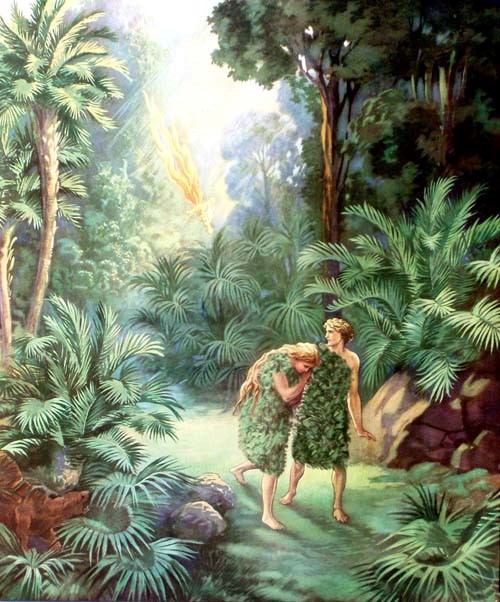
Adam and Eve now found themselves outside their garden home with no access to the “tree of life” which sustained their lives. You can well imagine their despair and anguish. Adam knew that he had no hope of a future life; he understood that death meant extinction. What Adam didn’t know was that even before he had sinned that God had a plan whereby Adam might have another chance of returning to God and his favor and to everlasting life on the earth.
Since God cannot countermand his laws and his character, his justice demanded that since Adam had sinned, Adam must die. (Psa. 97:2–NAS) But God’s love saw a way to satisfy justice and release Adam from the penalty imposed on him. In truth, God had planned for this contingence long before Adam was created—(1 Peter 1:18-20) God knew the human frame and God foreknew that Adam would sin. He did not cause him to sin, because this would have overridden Adam’s free will. But, God so knowing his creatures, knew that when Adam was presented with such a test, would fail.
God’s law of justice is stated in Deut. 19:21: “And thine eye shall not pity; but life shall go for life, eye for eye, tooth for tooth, hand for hand, foot for foot.” Justice is fairness, equality and implies a balance; thus, if you take a life, you must pay with your life. This is the basic idea of a ransom, the giving of a substitute to replace what was lost. 1 Tim. 2:6 it is stated that Jesus “gave himself a ransom for all, to be testified in due time.” The word “ransom” is from the Greek word anti-lutron, which means “a corresponding price,” or a substitute. If one could be found to take Adam’s place in death, then Adam could be released from the death penalty imposed upon him without violating God’s law. In the case of Adam, what exactly was a corresponding price? What kind of a substitute would it take to cancel out the penalty imposed? Was it any life for any life? Could anyone have ransomed Adam and bought him back so that he could live again? No, it had to be an exact equivalent, and that, before Adam sinned. Since Adam was perfect, the only life that could redeem him was another perfect life.

When Adam sinned he also plunged into death, not only himself, but also all those who would be born from him. While in the Garden of Eden, Adam and Eve did not bear children. If they had, then all of them would have been perfect and would have been subject to the same test as Adam—to see if they were worthy of everlasting life. Had one of them failed they also would have needed their own anti-lutron or substitute to take their place in death. God can only try a perfect being for everlasting life. An imperfect being would have no opportunity of passing such a crucial test. God cannot and does not deal with sin or sinful beings. Only a perfect being has the ability to stand before God and be tested. Adam and Eve did not produce offspring until after they had sinned. All of Adam’s children share in his sin: “Behold, I was shapen in iniquity; and in sin did my mother conceive me”—Psa. 51:5. Rom. 3:10: “As it is written, There is none righteous, no, not one” Since all shared in his sin, all will share in his recovery as shown in 1 Cor. 15:22.
God in his mercy had not forgotten Adam. As a matter of fact, even before the foundation of the world was laid (1 Peter 1:18-20), when it was yet “void and without form,” God had prepared for Adam’s recovery from sin and death. He even gave Adam and Eve a glimmer of hope veiled in the curse he gave to Satan through the serpent: “And I will put enmity between thee and the woman, and between thy seed and her seed; it shall bruise thy head, and thou shalt bruise his heel.” Here was an intimation of a future savior, a Messiah (the woman’s seed) that would ultimately “bruise Satan’s head,” or more exactly, deal him a death blow and through this, wipe out evil altogether.
Jesus, in his pre-human existence was the first and only creation of God. (Col. 1:15-17; Prov. 8:30) To him was given the high position of carrying out all of God’s plans and purposes. We might compare their relationship to that of architect and contractor. An architect designs a building, but never lifts a finger in the construction of it—that is the contractor’s job.
Jesus through all the eons of time had been the constant companion of the heavenly Father. He had been honored by God by giving him the honor of creating everything in the universe. (John 1:3–NAS) Already highly honored, God proffered the Logos (Jesus in his prehumen existence) an invitation to ransom Adam from the state of death. No doubt without hesitation the Logos deemed it a great honor to further carry out the Father’s plan. His attitude is expressed prophetically of Jesus in the words of the prophet Isaiah, “Also I heard the voice of the Lord, saying, Whom shall I send, and who will go for us? Then said I, Here am I; send me.” (Isa. 6:8)
So in due time God sent his son to redeem the world. Because Adam was a perfect man, Jesus had to become a perfect man. An angel cannot redeem a man, not being in the same form. Since Jesus was born of Mary and had God as his father, he was born a perfect man.
Jesus gave his life for Adam, becoming his substitute, his anti-lutron. Here he laid down his human life to redeem Adam and his posterity from the curse of the Adamic death. He gave up his humanity, his human body for this very purpose (1 Peter 3:18) and he cannot ever take back his human form, else the ransom would not be efficacious for life—the ransom price would no longer exist. In exchange for laying down his life, the Father rewarded him with the divine nature, the same nature as his father. He had no need of a human body in the heavens. To possess the divine nature means that one can never die. All other beings in the universe are mortal and must be sustained by outside factors to maintain their lives.
 Canadian Bible Students
Leave a comment